Let me get two rules out of the way right off the bat.
Rule #1: Don't buy a banjo on eBay.
Rule #2: If you ignore Rule #1, know what you are doing.
eBay is a great market but suffers from the same affliction as all online markets - the buyer can't handle the goods before the sale. That's a severe limitation where musical instruments are concerned because it means the buyer can't hear the instrument in advance. Musical instruments are all about sound and feel. Because no two instruments are alike, only by hearing the instrument can one satisfy themselves about its quality, character, and playability.
Table of Contents
My Gold Star G12
Buying = Selling
The Written Word
The Holy Grail: Photographs
Taking the Right Shots
The Fastie Photograph Suite
Setting the eBay Price
My friend Paul Hawthorne used to say that one should be willing to drive anywhere within an eight hour radius to see a banjo before committing to its purchase. Perhaps that's a bit extreme; Paul also used to drive 150 miles to see his dentist. Nonetheless, he had a point. How far are you willing to travel to make sure the banjo is what you want?
Your degree of due diligence must of course be weighed against your particular situation. The price of the banjo is clearly relevant; the purchase of an old Harmony for $100 risks little, while $50,000 for an alleged Gibson tips the scale light-years in the opposite direction.
If you've gotten this far, I'll assume you plan to ignore Rule #1. Therefore, Rule #2 rules - know what you are doing.
My Gold Star G12
As I began to study Asian banjos in 2003, I began to take interest in obtaining a better one. I bought one on eBay in late 2005, about two years after I had begun my research. By the time I made the purchase I had learned how to read eBay listings between the lines and how to assess the photographs. I had seen several Gold Stars in the flesh and thus could relate reality to the pictures. I had learned enough about the brand to know what to look for in those pictures and what questions to ask the seller. By the time I bought, I had rejected several eBay auctions for one reason or another.
Rule #3: Don't be afraid to walk away.
It is vital that you prepare yourself for this. If you become emotionally attached to your goal of obtaining a particular banjo, you will almost surely make a mistake. The worst mistake is paying too much because you allow yourself to be swept away by the bidding.
The supply of vintage Gold Star banjos is obviously limited. In spite of that, I was willing to ignore any auction that left me with any sort of question. In my case I saved about $300. I had been very interested in an instrument that eventually sold for $1400 but about which I had some nagging discomfort. Then the G12 came along, in every respect a better instrument and an archtop to boot! I was able to talk to the seller, who happened to be a music dealer. I bought it on the spot and got a great instrument at a great price.
The moral is that another banjo will come along. Have some patience and don't be afraid to just say no.
Buying = Selling
Although this essay is titled "...Buy or Sell...," it is really about how to construct a good eBay listing for a banjo. If you are selling, the essay will help you put together a better, more effective and more successful listing. If you are buying, the essay will help you know what to look for so you will know when to fold.
If you are selling, here's an important rule.
Rule #4: Tell the truth (aka The Golden Rule).
I understand and appreciate that eBay listings are ads and thus subject to, shall we say, an expanded version of the truth. For banjos, I don't think it helps much. The clearer, more direct, and honest a listing is, the better I think it will do. My experience on eBay is that most of the buyers of banjos are pretty savvy. It will be hard to fool them.
The biggest "expanded truth" I see in banjo listings is that the banjo is a "pro-quality" instrument. First, any instrument in the hands of a gifted musician will sound like a quality instrument. Second, this line is just a blatant and, to my mind, unfriendly attempt to push up the selling price by playing on the buyer's emotions - who wouldn't want a professional instrument at a bargain price?
Another line in the same vein is "I'm a pro and I played this instrument for several years, blah, blah, blah." I only accept this statement if the "pro" provides his or her name and I've only seen that happen twice.
It is the seller's responsibility to assure that the listing accurately reflects the condition and configuration of the banjo. Answer these questions:
- Are all the parts original? If not, what has been replaced? Are the original parts included in the sale?
- Has the banjo ever been repaired? Why?
- Are there any defects? Are there belt buckle marks on the resonator? Are the metal parts pitted or corroded?
If you are buying, do your research so you can detect the exaggerations and perhaps a few outright lies here and there.
The easiest way to do research on eBay is to watch for a few weeks or months, keeping track of what you've seen and what the listings say. A quick way to do research is to search for completed items. This can show you both recent selling prices and listings that ended without a bid. I've seen cases in which the current listing is for a banjo that did not sell just days or weeks earlier. What does it mean?
As a cautious buyer, always ask yourself "Why?" Why is this banjo not being bid up to what I think it's value is? Why didn't it sell last week? Why won't the seller respond to my question? Why is there no photo of the fretboard or inside the pot? Why?
Rule #5: Beware the eBay scam.
Asking why should also extend to the identity and record of the seller. Does the seller have a positive feedback record? Does the seller have any feedback? (Beware zero-feedback or brand new sellers.) Does the seller identify his or her geographical location? What is the nature of responses to questions? Does the listing sound too good to be true?
Rule #6: ALWAYS ask at least one question.
If your neighbor was selling the banjo, you'd hop right over not only to see it but to talk about it. Communicating with an eBay seller is not quite the same but it's sure better than nothing. I think anonymity is the curse of the Web; it's surprising what you can accomplish if you can break that down a bit.
Rule #7: If you can't get answers, don't buy. Period.
If you read back over this section you'll find the theme. Don't buy blindly. Have some kind of dialog with the seller to satisfy yourself about the character of the seller and the content of the listing. If you can't touch and feel the instrument, it's essential that you substitute something else.
The Written Word
The ability of the seller to write should not in and of itself affect a buying decision. There is a lot of badly mangled English in eBay listings. The listing should be as clear as possible in describing the banjo but the most important thing is that the information you need is there, not that the seller writes like Shakespeare.
There are a few mechanical things about the listings that you can avoid if you are the seller. The worst listings are those without paragraph breaks because they are very difficult for most of us to read. Your listing will do better if it is easy to read and that means breaking up the prose into appropriately sized, well-organized paragraphs. If you are having a technical problem getting paragraph breaks, find somebody to help you. A single block of text on the page is terrible to read but very easy to fix.

The serial number and sometimes the model number are often inside the pot of the banjo.
Do not write the description in all capital letters. If this is something you do, ask yourself a question: Why is it that we have upper and lower case letters in the first place?
Assuming you're over the formatting hump, describe the banjo as best you can. Be sure to include its brand, the model designation if you can find it, and the serial number. Always be sure to note any defects or imperfections.
There is a temptation to explain why you are selling the banjo. Try to resist it. eBay is a market; like everyone else, you are exchanging goods for cash. If a potential buyer wants to know more, he/she will ask. The problem is that many explanations sound like sob stories and in every case I've watched affected the selling price negatively.
The Holy Grail: Photographs
Photographs can make or break a listing.
Rule #8: Take the best photos you possibly can.
Let's start by talking about how to take the photographs using a digital camera. The easiest and most effective way to get good banjo photographs is to take them outside in full sunlight at high noon in front of greenery. Banjos always look great against a backdrop of green grass or a nice yew. If you need proof of this, visit Turtle Hill Banjos. Dave Schenkman takes all his photos on the lawn and they all turn out well. Sunlight is best because the lighting is even all around the banjo. High noon is best because there are fewer shadows. Photos taken like this will rarely need any adjusting with a software photo editor.
Outside shots in sunlight require the least fooling around with your camera. Set your camera on automatic and shoot away. Take lots of shots! It's much more efficient to take many shots while you've got the banjo out and set up than it is to discover you need to retake a few because they didn't turn out. Take several snaps of each shot you need and you're almost sure to have a good one of each.
If you notice that your flash is firing for the outside shots, check the results. Sometimes the flash helps by filling shadows but sometimes the flash can throw off colors a bit. If you see a problem and your camera has a P setting, use it instead. Just be sure to set proper exposure settings - P means "programmed" and you are the programmer.
If you must shoot the photos indoors, know your camera and make the
appropriate settings. If you don't know the right settings, experiment until
you get shots that look good and then use those settings. The most important
setting for indoor shots is "white balance." If your camera can't set white
balance, just experiment with various exposures under different lights and
with and without flash. If you can set white balance, set it for your
circumstances.
 You will probably find that the most difficult lighting is
fluorescent; the combination of the camera's flash and its white balance
setting can often lead to terrible photos. Fluorescent light usually does not
flatter a banjo.
You will probably find that the most difficult lighting is
fluorescent; the combination of the camera's flash and its white balance
setting can often lead to terrible photos. Fluorescent light usually does not
flatter a banjo.
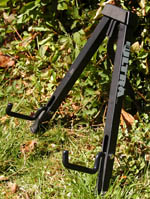
The best way to pose a banjo for photos is on an instrument stand that does not have a high neck support. I own a Kaman Ultra Fold-Away stand (model 6041). When a banjo is sitting on it, the stand is almost invisible. I like this stand very much but it is getting a bit hard to find; perhaps Kaman's Hercules GS401B stand is its replacement but I'm not sure it is an improvement.
Finally, how should you resize your photos? The simplest approach is not to do any resizing yourself. Just choose your photos, upload them, and let eBay make the adjustments. This is an especially good technique if you plan to purchase the "supersize" option, which allows the shopper to click on an image to see a larger, 800x600 photo. eBay will then automatically make the thumbnails, the normal photo, and the larger one. It's also a good technique if you don't have any photo software (paint.net is free).
When resizing photos, tell your software one of the dimensions and let it figure out the other one. Most photo editors will do this, calling it something like "maintaining aspect ratio." If you force both dimensions to a particular size, the image might be distorted if the ratio between the height and width of the resized photo is different than the original.
Also, if your software allows, set the "resolution" to 96dpi.
One problem with this approach is that uploading full-size photos right from your camera can take extra time, especially on slower connections. If you can resize photos, a compromise is to resize the photos from their full size to the maximum size that eBay uses, 800x600. If you choose this option, set the JPEG quality to 75% or more and be sure to save the resized photos under a new name so you don't lose the original. As an example of this, I resized a 2272x1704 image taken with a Nikon Coolpix 5700 to 800x600 and cut the file size in half. The resulting photo was excellent, more than adequate for eBay.
If you are not going to use the eBay supersize feature and you have software to resize, I recommend resizing to about 640x480 with 75% quality or better and leaving the rest to eBay.
Taking the Right Shots
Now that you know how to take the best photos, you need to make sure you take the right shots.
Rule #9: Don't skimp on photographs.
The epidemic problem with most eBay banjo listings is that there are too few photographs. Because of the banjo's inherently mechanical nature, more photographs are needed than for other instruments. Sellers will get better results with a comprehensive set of photos because buyers will be able to get the visual information they need and deserve.
An eBay listing costs more for each photograph added. It is money well spent.
Rule #10: Avoid the vertical. Avoid the horizontal.
Photographs are rectangular. It is natural to align the banjo with the orientation of the rectangular image. It is also a mistake.
Viewfinders and LCDs on digital cameras usually show
an image slightly smaller than the actual photograph. If you
compose a shot with an object very close to the edge of the view, the object
will appear a bit further away from the edge in the final photo. Try it with
your camera. Most cameras show 95-98% of the view but I've seen some that go
as low as 80%.
Banjos are about 12" wide and about 34" tall, with a very skinny neck. In any photograph of a banjo the dominant feature will be the background. However, the purpose of eBay photographs is to document the item for sale in as much detail as possible. Therefore, the goal of the photographer should be to cover as much of the image as possible with the banjo, not the background.
When taking a photograph of the front of the entire banjo, from peghead to tailpiece, orient the banjo along the diagonal of the image. Try to compose the shot so the peghead and tailpiece are as close as possible to the opposing corners. This composition assures the largest possible banjo image within the rectangle and the least amount of background.
The Fastie Banjo Photograph Suite
These are the photos I recommend for a banjo listing on eBay. Note that they are a bit smaller than the typical eBay photo will be.
Yes, there are a lot of photos. The more complete your collection of photos for an eBay banjo listing, the better the listing will perform.
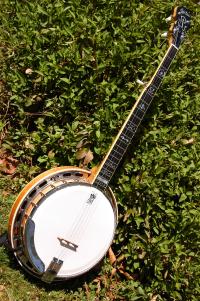 |
Full FrontA full shot of the front, taken at an angle, is essential. This is what I mean by a full shot oriented along the diagonal instead of vertical. Look awkward? You're right - I put the peghead in the wrong corner. I should have oriented the banjo from upper left to lower right. These are the lessons that one learns through trial and error. Once I realized the error, I took the correct shot. I left this one here as a case in point. Notice that you can see pretty much every important detail of the banjo - the inlay, the peghead design, the tuning pegs, the 5th string tuning peg, the side of the pot, the purfling on the resonator - almost everything. |
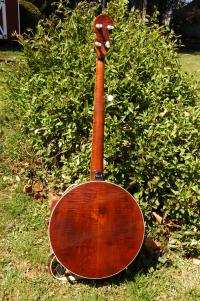 |
Full RearA full shot of the back is essential. I purposely used an upright shot instead of the diagonal shot as shown above. Compare this to the photo above and notice that the pot in this shot takes up less space. This upright shot is certainly informative and useful, but it's much harder to see detail in it. This is going to be a matter of taste. I admit I rarely see the diagonal shot even though I think it is better. |
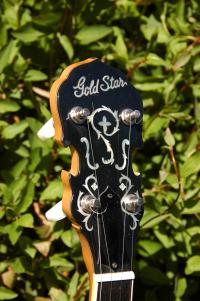 |
Peghead Close-UpThere is always a lot of detail at the peghead of any banjo. The design and inlay is most important. The tuning pegs, nut, truss rod cover and the first fret (not shown here) are other details of interest. This shot is shown exactly as it came from the camera. It would have been better if I had gotten a tighter shot or cropped the photo with software in order to show more detail. Note that the shot is taken in slight profile, giving the image some depth. |
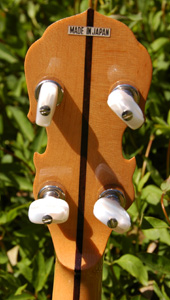 |
Peghead Close-Up, RearThe rear of the peghead is important primarily because it shows the tuning pegs. On some banjos, the serial number is stamped at the top, where the "Made in Japan" sticker is on this one. I did crop this photo. Notice how much more detail is evident in this one as opposed to the one just above. It probably would have been better to take this shot at an angle, which would have shown the tuning pegs in profile. Note that doing so might have made it harder to read a stamped serial number. |
 |
First Five FretsMost banjos get played very heavily on the first five frets. A shot like this one can help show how worn the fingerboard is at these fret positions. I'm torn on how to present this particular shot. Here I've shown the neck including the peghead. However, it might be more useful to have a close-up of just the area from the 5th string peg to the nut. A bit of a profile can also be helpful because if the fingerboard is heavily worn and thus pitted, it could show up. Be warned, however, that it is very difficult to see deep wear no matter how good the photo. Wear in this area is a good topic of conversation between buyer and seller. |
|
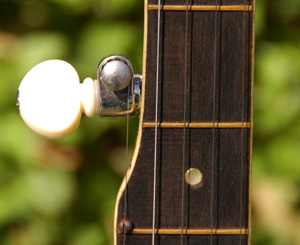
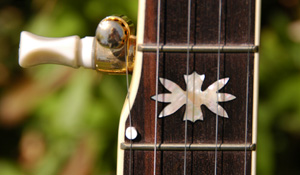
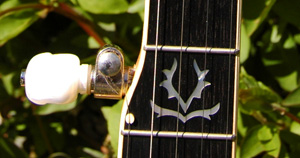
Fret FiveOn a five string banjo, the 5th fret is an area of interesting detail and is thus worthy of its own close-up photo. The most obvious part, of course, is the side-mounted tuning peg. This is also the spot where the neck profile changes to accommodate the 5th string. An often overlooked detail is the way the nut for the 5th string is constructed. In these examples you can see very clearly that the tuning peg is not mounted the same way relative to the position of the 5th fret. The top photo is my old Harmony. The peg is mounted behind the 4th fret. This is quite unusual but look closely - it results in the 5th string running almost straight to its nut. The nut is also unusual - a slotted screw. The next photo down is my Fender FB-59. Here the peg is mounted very close to the 4th fret but slightly further up the neck. The nut is the conventional cylindrical bone nut mounted just behind the 5th fret. The last photo is my Gold Star G12. In this case the peg is almost centered between the 4th and 5th frets. Note the color of the peg's metal in the the second and third shots. The Gold Star's hardware is nickel but it seems to have a gold cast. I have seen one case on eBay where the seller claimed gold hardware on a model that was never made with gold. Talk to the seller! |
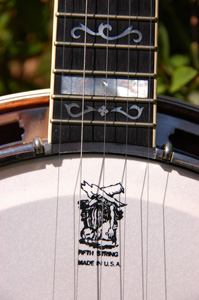 |
Neck at Pot - Special InlayThe join between the neck and the pot is always a good photo to include. It is especially so if there is a special inlay at the 21st fret. This is where Gibson banjos say "Mastertone" in an inlaid pearl block. My Gold Star G12 has a blank block inlay in this spot, as shown in the photo. This particular shot also shows a truly rare item, a Fifth String head. This was original equipment on Gold Stars of the era and exactly the sort of thing you want to highlight. Of course, you must know the history to realize the significance. Because the shot is a close-up, it clearly shows that the banjo is an archtop. |
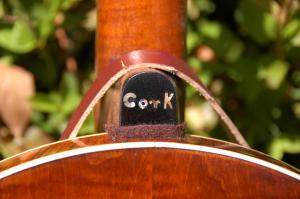 |
Heel (optional)The heel of the neck, the part of the neck that attaches to the rim of the banjo, is usually not interesting but sometimes has a distinguishing feature. Corky Wirick, the builder of my Woodsong banjo, always inlaid his name in the bottom of the heel, a unique finishing touch. Some fancier banjos have an ornamental carved heel. The heel is sometimes the location of a problem. If there is something odd at the heel joint, be nice and include that shot. |
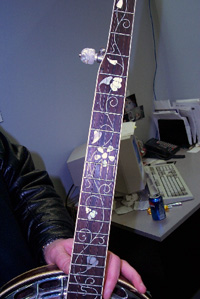 |
Decorative Items (optional)Your banjo may have other decorative elements. All of them, no matter where on the banjo, should be shown with their own photos. My banjos are relatively plain. My Canadian friend Steve Latimer sent me this shot of the vine inlay on his Aria Pro II Deluxe so I could use it as an example here. The neck is always a challenge because it is so thin and long. In a case like this, one additional close-up shot showing one section of the vine in greater detail would be a good idea. |
|
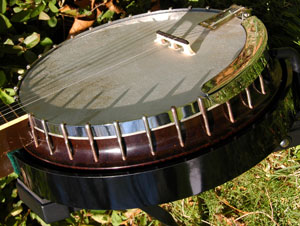
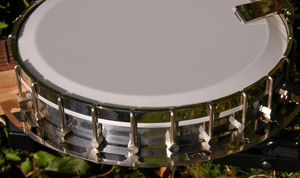
Pot Profile - The Money ShotThe #1 mistake folks make is taking a photo of the pot from directly in front of the banjo. It becomes a two dimensional image that communicates very little. Always use a profile shot instead. Here's what you can see in this profile of my Gold Star's pot:
The profile of my Harmony shows:
Finally, the profile of my Saga kit banjo:
There is a huge amount of information in a good pot profile. That's why I call it the money shot. |
|
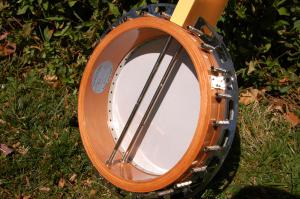
Pot InteriorThe #1 missing photograph from most eBay listings is the inside of the pot. Again, there is a ton of information.
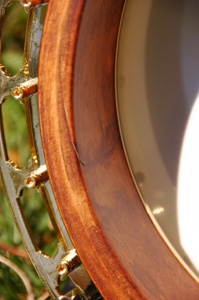
Unless you absolutely, positively know what you are doing and know what you are getting in a particular banjo, do not buy a banjo on eBay if this photo is not supplied. One of the most difficult things to see in this image is how the rim is constructed. Wood rims are either 3-ply, multi-ply (more than 3 plies), or block. Block rims are usually easy to spot. But can you tell from the full photo whether the Gold Star rim is 3-ply or multi-ply? (It's the latter.) A close-up, detail shot of the rim can help. Here you see the large lap joint on the inside ply of my Fender FB-59, a sure clue that it is a 3-ply rim. A closer shot of the bottom of the rim could also allow the plies to be counted, depending upon the finish. |
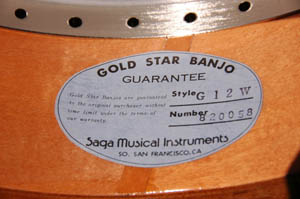 |
Serial NumberIf there are any labels or marks identifying the banjo, individual close-ups of those details are extremely important. All the better instruments have a label like this, usually inside the pot. Do not be afraid to remove the resonator to get this shot. No matter where the serial number is, be sure to include a photo showing it. |
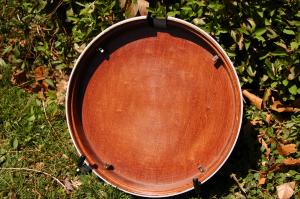 |
Resonator Interior (optional)On most banjos the inside of the resonator is not very interesting. There are some exceptions. Some banjos, especially Gibsons, have the serial number on both the rim and the resonator. If that is the case, this shot is not optional. Some banjos designed for clear heads have designs on the interior. The design will photograph better this way than through the head. |
|
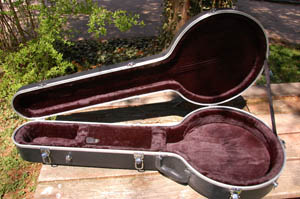
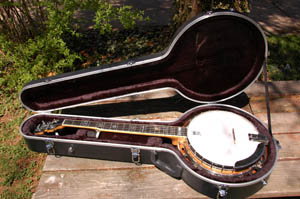
CaseIf you are selling a case with the banjo, always include a photo of it, preferably open. This is a very difficult photo to take because the inside of a case is often very dark. Here I let the sunlight fall directly on the inside, to good effect. However, I made a mistake with the white balance setting on the camera for this shot - the inside of this case is black, not purple. Always make sure you have the white balance setting correct or set your camera to automatic. If you have a case with something interesting on the outside, such as a brand name, add another photo of the case showing that feature. I prefer to see the case empty with as much interior detail as possible. I'm going against the grain here; almost every eBay listing I've seen shows the case with the banjo. |
Setting the eBay Price
I can't help you decide how much your banjo is worth. I don't appraise and I'm not an expert. Take my advice here with a grain of salt.
The real challenges with eBay pricing are deciding upon the initial asking price and whether to use eBay's reserve or "buy it now" features. Here I can only offer my personal experience in about 250 eBay transactions as both buyer and seller.
I believe in the power of markets. My preference is to set a low asking price and let the market take its course. Sometimes I must settle for less than I would have liked but more often than not I do better when the bidders compete. I believe the extra time I take to create honest, comprehensive listings is the foundation upon which this rests.
Setting a reserve price can offer some peace of mind. If the the bidding does not reach the reserve, the item does not sell no matter how much bidding has taken place. However, I believe reserve prices tend to restrain bidding. Before the reserve is reached bidders seem more cautious. After the reserve is reached bidders know the value you have set, further moderating the price. In other words, I believe reserve prices tend to lower the final selling price. And if you attempt to mitigate that effect by setting a high reserve, I think bidders just say no.
Full disclosure: I have used reserve prices to protect some of my eBay transactions. These have worked out for me; I believe it is because I set the reserve very low.
The character of buy it now (BIN) prices has changed in the few short years I've been using eBay. At first, almost all BIN prices vanished after the first bid. The intent was clearly to let the first bidder take the item immediately by paying exactly what the seller wanted. More recently, BIN prices have become simply the only price the seller is willing to accept. I see them used more and more to eliminate the bidding and thus, in my opinion, any market effect.
My methods should not trump your instincts or personal circumstances. I offer no guarantee of any kind that my approach will yield a better result.